
Kimi K3 vs GPT-5.6 Sol: Complete Benchmark and Pricing Comparison (2026)
Kimi K3 vs GPT-5.6 Sol compared on every major benchmark, real pricing, independent verification, and the specific tasks where each model actually wins. The complete 2026 breakdown.
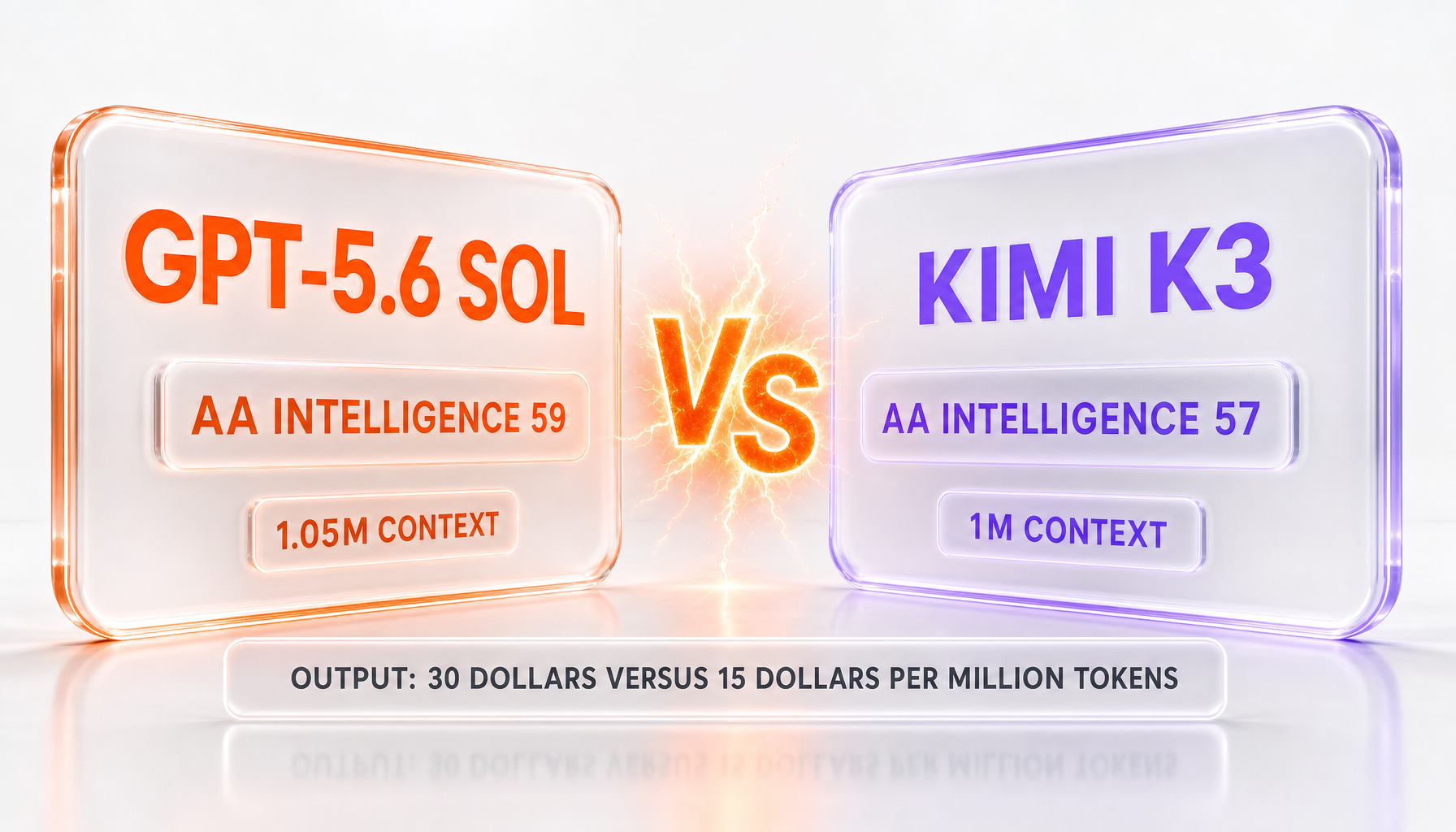
If Kimi K3 vs Claude Fable 5 was about an open-weight underdog chasing the strongest model on the market, this comparison is different. GPT-5.6 Sol is priced closer to K3 to begin with, and the benchmark gap between them is thinner than almost any other frontier matchup this year. Here's the complete picture, benchmark by benchmark, with the pricing math that actually decides this one.
Why This Comparison Is Different From K3 vs Fable 5
Claude Fable 5 sits at the very top of the market on price and, mostly, on capability. GPT-5.6 Sol occupies a different spot entirely: OpenAI built it specifically to be frontier-competitive while costing meaningfully less than Fable 5, and Kimi K3 is now positioned to undercut Sol the same way Sol undercuts Fable 5. That makes this specific matchup, K3 versus Sol, the one where price and performance are genuinely close on both sides, rather than one model clearly outclassing the other on cost.
Meet the Two Models
GPT-5.6 Sol launched July 9, 2026 as the flagship tier of OpenAI's three-model GPT-5.6 family (Sol, Terra, Luna). It's built for complex reasoning and long-horizon agentic work, with new Max and Ultra reasoning modes, the latter delegating work across coordinated subagents for faster completion on the hardest tasks. It reached full general availability after a roughly 12-day restricted preview tied to a government cybersecurity review.
Kimi K3 launched a week later, on July 16, 2026, as Moonshot AI's newest flagship. It's a Mixture-of-Experts model with roughly 2.8 trillion total parameters, the largest open-weight model released to date, with a 1,048,576 token context window and native image understanding. Full open weights are promised by July 27, 2026; today it's accessible through Moonshot's API and the Kimi app.
Benchmark Comparison
Moonshot's own launch materials included a direct comparison against GPT-5.6 Sol across the same benchmark suite used against Fable 5. As with that comparison, a methodology note applies here too: K3 was tested through Kimi Code, Sol through Codex, meaning harness conditions weren't fully identical.
| Benchmark | Kimi K3 | GPT-5.6 Sol | Who leads |
|---|---|---|---|
| SWE Marathon (long-horizon coding) | 42.0 | 39.0 | K3, by 3 points |
| Program Bench | 77.8 | 77.6 | K3, essentially tied |
| Terminal Bench 2.1 | 88.3 | 88.8 | Sol, by half a point |
| DeepSWE | 67.5 | 73.0 | Sol, by 5.5 points |
| FrontierSWE | 81.2 | 71.3 | K3, by nearly 10 points |
| Kimi Code Bench 2.0 | 72.9 | 64.8 | K3, by 8.1 points |
| Automation Bench | 30.8 | 29.7 | K3, narrowly |
| SpreadsheetBench 2 | 34.8 | 32.4 | K3, by 2.4 points |
| BrowseComp (long-context search) | 91.2 | 90.4 | K3, narrowly |
| JobBench | 52.9 | 46.5 | K3, by 6.4 points |
This table tells a clearer story than the Fable 5 comparison does. Across the ten benchmarks Moonshot published against Sol, K3 leads on eight of them, sometimes by wide margins on FrontierSWE, Kimi Code Bench, and JobBench. Sol's only clear advantages show up on DeepSWE and, by a razor thin half point, Terminal Bench 2.1, the specific benchmark OpenAI has leaned on most heavily in its own launch messaging. That's a meaningfully different picture than K3's more evenly split results against Fable 5.
The Independent Check: Artificial Analysis
Moonshot's own numbers favor K3 heavily in this matchup, which makes third-party verification even more important here than usual. Artificial Analysis's Intelligence Index v4.1 tells a closer story than Moonshot's table suggests: GPT-5.6 Sol scored 58.9 at max reasoning effort (and higher still on its xhigh setting), while K3 scored 57.1, putting Sol narrowly ahead on the composite measure despite K3's dominance across Moonshot's own coding-specific benchmarks.
That split is worth sitting with. It suggests K3 may have a genuine, real edge specifically on coding and agentic tool-use tasks, the exact category Moonshot's table measures, while Sol retains a narrow overall reasoning advantage across the fuller range of tasks the Intelligence Index covers, including areas outside pure coding. Neither company's framing fully captures that nuance on its own.
On Artificial Analysis's more granular measures, K3 posted a Coding Index score of 76.24, running at roughly 62 output tokens per second with a 1.99 second time to first token. On AA-Briefcase, a private long-horizon knowledge work evaluation, Artificial Analysis's own summary noted that GPT-5.6 Sol still leads specifically on presentation quality, even as K3's overall rubric scoring and analytical quality landed close to Fable 5's level in that same test, an indirect signal that K3's strength is substance over polish relative to Sol.
The same caveat that applied to K3's rising hallucination rate in the Fable 5 comparison applies here too: accuracy on AA-Omniscience improved from 33 to 46 percent generation over generation, but the hallucination rate climbed from 39 to 51 percent over the same period. That tradeoff matters for any workload where getting a factual answer wrong carries real cost, regardless of which model you're weighing it against.
Pricing: The Real Story of This Matchup
| Kimi K3 | GPT-5.6 Sol | |
|---|---|---|
| Input (per 1M tokens) | $3.00 | $5.00 |
| Output (per 1M tokens) | $15.00 | $30.00 |
| Fast mode | Not offered | $12.50 input / $75 output via Cerebras, up to 750 tokens/sec |
| Context window | 1,048,576 tokens | 500,000 tokens (1M planned) |
| Open weights | Promised July 27, 2026 | Closed, proprietary |
This is where the comparison becomes genuinely compelling on K3's side. Sol costs exactly double K3 on both input and output tokens, and K3's context window is already more than double Sol's current 500K limit, before OpenAI's planned upgrade. Combine that with K3 leading on eight of the ten benchmarks Moonshot published, plus landing within two points of Sol on the independent Intelligence Index, and the value argument for K3 in this specific matchup is stronger than in the Fable 5 comparison, where the price gap was similar but K3 trailed on the composite score by a slightly wider margin.
Where Each Model Actually Wins
GPT-5.6 Sol's real advantages: a narrow but real edge on the independent composite Intelligence Index, a clear lead on DeepSWE, essential parity on Terminal Bench 2.1 (OpenAI's own headline benchmark), and access to Ultra reasoning mode's subagent coordination for the hardest individual tasks, plus a mature, fully public model with no dependency on a future weights release.
Kimi K3's real advantages: wide, verified-by-Moonshot leads on FrontierSWE, Kimi Code Bench, JobBench, and SWE Marathon, a context window already more than double Sol's current limit, and a price point exactly half of Sol's on both input and output tokens, with open weights arriving within days of this comparison being written.
Should You Actually Use It
Choose GPT-5.6 Sol if you want the model with the narrow independent intelligence edge today, need Ultra mode's subagent coordination for genuinely hard, high-stakes tasks, or want a fully mature, publicly available model without waiting on an open weights release.
Choose Kimi K3 if your workload is specifically coding and agentic automation, where Moonshot's own data shows real, wide leads, you want double the context window at half the price, and you're comfortable running a pilot now with the understanding that full independent verification arrives once the weights ship on July 27.
Test both directly on your actual tasks if you're choosing infrastructure rather than picking a chat assistant. The gap between these two is close enough, and the pricing difference large enough, that a real trial against your own workload will tell you more than either company's launch benchmarks.
Bottom Line
This is the tightest price-to-performance matchup in this entire model comparison cycle. GPT-5.6 Sol holds a narrow, independently verified lead on overall intelligence and keeps pace on the one benchmark it's built its reputation around. Kimi K3 wins decisively across Moonshot's own broader coding and agentic benchmark suite, doubles Sol's context window, and costs half as much. Unlike the Fable 5 comparison, where Fable 5's overall lead was clearer and wider, this is a genuine coin flip on paper, with the deciding factor likely coming down to whether your workload leans toward raw reasoning breadth, where Sol edges ahead, or coding-specific agentic execution, where K3's advantage is real and independently corroborated in part by Artificial Analysis's own testing.