
KAT-Coder Pro 2.5: The Coding Model That Ranks Second Only to Opus 4.8
KAT-Coder Pro 2.5 explained. Full breakdown of benchmarks, pricing, architecture, and setup with Claude Code, including how it stacks up against Claude Opus 4.8 and the rest of the frontier field.

A model built by a short video company's AI research division is now sitting closer to Claude Opus 4.8 on real software engineering benchmarks than most household name competitors. That's not marketing spin, it's what Kwaipilot's own published technical report shows. Here's the complete picture of KAT-Coder Pro 2.5: what it actually scores, what it costs, and where the claim needs context.
What Is KAT-Coder Pro 2.5?
KAT-Coder Pro V2.5 is the flagship coding model in Kwaipilot's KAT-Coder family, built by Kuaishou Technology's AI research division and served through its enterprise platform, StreamLake. It's positioned explicitly as an agentic coding model designed to take on complete issues and end to end business workflows autonomously, locating, modifying, and verifying changes across a real repository rather than generating isolated code snippets.
Pro sits at the top of a three tier family. Air is the lightweight, budget sibling built for less demanding, higher volume work. A third branch, the Exp open source line including KAT-Dev-72B-Exp and KAT-Dev-32B, releases select research weights publicly. Pro is the model Kwaipilot builds its strongest capability claims around, and it's the one with an actual, independently referenceable benchmark table behind it.
Specs at a Glance
| Spec | KAT-Coder Pro V2.5 |
|---|---|
| Developer | Kwaipilot (Kuaishou) |
| Architecture | Mixture-of-Experts, 72B active parameters out of 1T+ total |
| Context window | 256,000 tokens |
| Max output | 80,000 tokens |
| Input pricing | $0.74 per 1M tokens |
| Output pricing | $2.96 per 1M tokens |
| Access | StreamLake API, OpenRouter, Atlas Cloud, Novita AI |
| License | Proprietary, hosted access only |
| Modality | Text only, no vision support |
The Architecture Behind the Benchmarks
Kwaipilot's core research bet with the V2.5 generation is that further gains in agentic coding come primarily from training infrastructure, not raw scale. Pro V2.5 runs on a Mixture-of-Experts design activating 72 billion parameters out of a total pool exceeding 1 trillion, a similar activation strategy to other frontier MoE models, but the more interesting story is what feeds that architecture during training.
A system called AutoBuilder reconstructs real, multilingual code repositories into reproducible, executable sandbox environments with verified fail-to-pass and pass-to-pass states, generating self-contained training tasks at scale rather than relying on synthetic or single-turn code completion data. A companion system, KwaiClawEnv, synthesizes large volumes of realistic tool-use trajectories from actual executable services rather than scripted scenarios. On top of that data foundation, Kwaipilot scaled reinforcement learning using harness randomization and an asymmetric actor-critic PPO setup with hindsight-augmented value estimation, then fused five separate domain expert models, covering SWE, agentic tool use (internally called Claw), and web coding, into a single unified model through what the team calls Multi-Teacher On-Policy Distillation.
One specific infrastructure fix is worth calling out because it explains a lot about Pro's real-world reliability. Early in training, Kwaipilot found that roughly 16 percent of reinforcement learning failures came from the sandbox environment itself misreporting results, not from genuine model errors. After hardening the sandbox, that error rate dropped below 2 percent and training timeouts fell from 6 to 7 percent to under 1 percent. That's the kind of unglamorous engineering work that doesn't show up on a benchmark chart but directly affects how reliably the model completes long, multi-step agentic tasks in production.
Benchmarks: The Full Breakdown
This is where Pro V2.5 earns its reputation, and unlike its Air sibling, the numbers here are independently referenceable against a named panel of frontier competitors.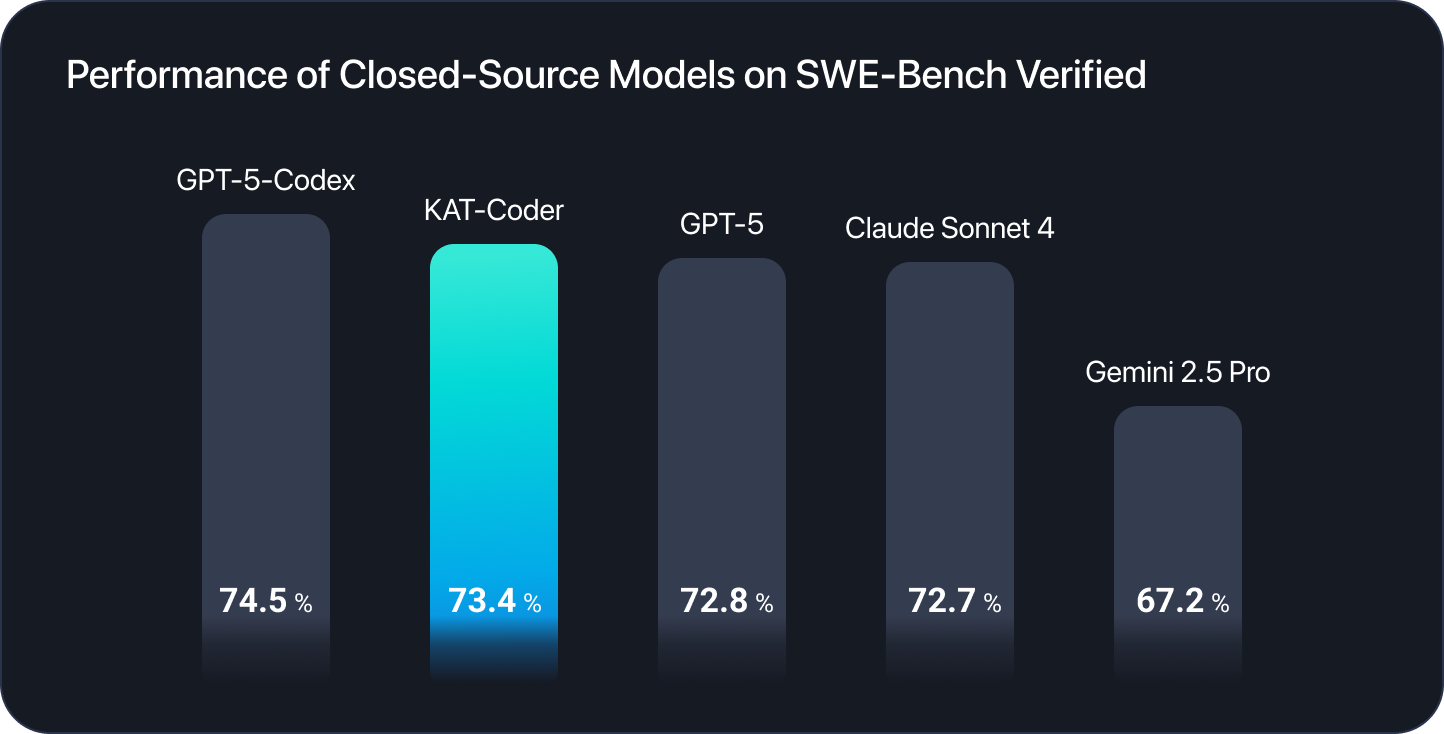
Head-to-Head Against Frontier Models
Kwaipilot's technical report compares KAT-Coder-V2.5 directly against GLM-5.1, GLM-5.2, Kimi-K2.6, and Claude Opus 4.8 across six benchmarks spanning coding and agentic tool use.
| Benchmark | KAT-Coder Pro V2.5 | Comparison |
|---|---|---|
| SWE-Bench Pro | 65.2% | Second only to Opus 4.8, outperforms GLM-5 series and Kimi-K2.6 by clear margins |
| KAT Code Bench (Kwaipilot's internal repository-level benchmark) | 53.1% | Second only to Opus 4.8 |
| PinchBench (agentic tool use) | 94.9 | Best overall result in the comparison set, edging out Opus 4.8 |
| KAT Claw Bench (business-grounded agentic tasks) | 85.5 | Tightly competitive with the strongest proprietary and open peers |
| Terminal and scientific coding | Competitive | Larger general-purpose models show a modest advantage here |
The pattern across these results is consistent: on realistic, repository-level software engineering, Pro V2.5 is the strongest system evaluated short of Opus 4.8 itself, reflecting genuinely robust repository comprehension, cross-file localization, and verification-driven repair. On agentic tool use specifically, it doesn't just come close to the frontier, it takes the top score in its comparison set.
Independent Third-Party Verification
Artificial Analysis has separately evaluated the KAT-Coder-Pro line and confirmed a similar competitive position. The prior generation, KAT-Coder-Pro V2 (the 1210 release), scored 64 on the Artificial Analysis Intelligence Index, placing it in the global top 10 and ranking first among all non-reasoning models evaluated at the time. On more granular measures, that same generation posted a Terminal-Bench Hard score of 0.492 and a GPQA score of 0.855, indicating strong technical reasoning and reliable command-line task handling, while ranking 57th of 391 tracked models overall and 22nd of 296 specifically on agentic tasks.
Historical Reference Point
The original KAT-Coder-Pro V1 scored 73.4% on SWE-Bench Verified, which Kuaishou reported as exceeding both GPT-5 and Claude Sonnet 4 on that specific benchmark at the time of release, an early signal of the trajectory this model family has followed generation over generation.
What "Second Only to Opus 4.8" Actually Means
It's worth being precise about the claim rather than just repeating it. Pro V2.5 doesn't beat Opus 4.8 across the board, and Kwaipilot's own report doesn't claim that. It ranks second specifically on repository-level software engineering benchmarks (SWE-Bench Pro and KAT Code Bench), while actually edging past Opus 4.8 on agentic tool use specifically (PinchBench). On terminal and scientific coding tasks, the report itself notes that larger general-purpose models retain a modest edge. So the honest framing is: Pro V2.5 is the strongest specialist coding model evaluated outside of Opus 4.8 on the tasks it was purpose-built for, with at least one category where it actually leads. It's not a blanket claim of frontier superiority, and treating it as one oversells what Kwaipilot itself is reporting.
Pricing and Where It Sits in the Market
At $0.74 per million input tokens and $2.96 per million output tokens, Pro V2.5 sits in a genuinely interesting middle position. It's meaningfully more expensive than its own Air sibling ($0.15/$0.60) and than budget open models like DeepSeek V4 Flash, but it undercuts several proprietary frontier models by a wide margin while reportedly delivering benchmark results in the same tier. For context, the previous generation Pro V2 was already noted by independent trackers as cheaper than 44 percent of comparable models at $0.30/$1.20, and Pro V2.5's price increase over that generation tracks with its meaningfully stronger reported benchmark performance.
How to Actually Use It
Kwaipilot has built out broad first-party integration support across the KAT-Coder family, and Pro V2.5 is the best-documented model in that lineup.
Claude Code. Route Claude Code through a StreamLake proxy by setting ANTHROPIC_BASE_URL to your StreamLake endpoint and ANTHROPIC_AUTH_TOKEN to your API key, then launch Claude Code as usual. Kwaipilot documents this as a three-step setup: request an API key and endpoint ID from the StreamLake Wanqing console, set the two environment variables, and start coding.
VS Code extensions. Kilo Code and Roo Code, two popular open source coding agents for VS Code, both support KAT-Coder through custom model configuration pointing at StreamLake's gateway URL.
OpenCode and Droid. Both support KAT-Coder-Pro-V2 style configuration through settings files pointing at the same StreamLake gateway pattern.
Cursor. Custom model configuration is supported for Cursor Pro plan subscribers and above.
Aggregator platforms. Pro V2.5 is also available through OpenRouter, Atlas Cloud, and Novita AI, useful if you want unified billing across multiple model providers rather than managing a dedicated StreamLake account.
Who Should Actually Use Pro 2.5
Pro V2.5 makes the most sense for teams running genuinely complex, repository-scale software engineering work, autonomous multi-file bug fixes, large refactors, or agentic workflows that need to reliably chain many tool calls together. Its independently verified benchmark position, genuinely second only to Opus 4.8 on the hardest repository-level tasks, makes it a credible option for production coding agents rather than just a promising budget alternative. It's a less obvious fit if your workload is lighter, more routine, or highly cost-sensitive, since Air offers a meaningfully cheaper entry point built from shared research, or if you need multimodal input, since Pro V2.5 is text only.
Bottom Line
KAT-Coder Pro V2.5 is one of the more credible non-frontier coding models on the market right now, backed by an unusually transparent technical report and independent third-party verification from Artificial Analysis rather than marketing claims alone. Its position, genuinely second only to Claude Opus 4.8 on real repository-level engineering benchmarks, and actually ahead of Opus 4.8 on agentic tool use specifically, is a legitimate result worth taking seriously if you're evaluating coding agents beyond the usual frontier lab shortlist. The infrastructure work behind it, particularly the sandbox reliability fixes and the AutoBuilder training pipeline, suggests this isn't a one-generation fluke either.