
Is Grok 4.5 Good Enough to Beat Fable 5? Honest Comparison
Grok 4.5 vs Claude Fable 5 — full benchmark breakdown, pricing comparison, and what real developers are saying after testing both. Which one actually wins for coding and agentic work?
Two of the biggest model launches of the year happened in the same week — and now everyone wants to know: does xAI's cheaper, faster Grok 4.5 actually hold up against Anthropic's frontier Claude Fable 5? Short answer: it depends whether you're optimizing for raw intelligence or for your token bill. Here's the full breakdown.
The Core Tradeoff, In One Line
Claude Fable 5 wins almost every benchmark that measures raw capability. Grok 4.5 wins almost every benchmark that measures cost-per-result. Neither side disputes this — even xAI's own launch messaging leaned into "Opus-class, but faster and cheaper" rather than claiming outright superiority over Anthropic's top-tier model.
Benchmark Breakdown: Where Each Model Actually Leads
| Benchmark | Grok 4.5 | Claude Fable 5 | Gap |
|---|---|---|---|
| Terminal Bench 2.1 | 83.3% | 84.3% | Fable +1.0 pt (close) |
| DeepSWE 1.1 (real GitHub issues) | 53% | 70% | Fable +17 pts |
| SWE Bench Pro | 64.7% | 80.4% | Fable +15.7 pts |
| Artificial Analysis Intelligence Index v4.1 | 54 | 60 | Fable +6 pts |
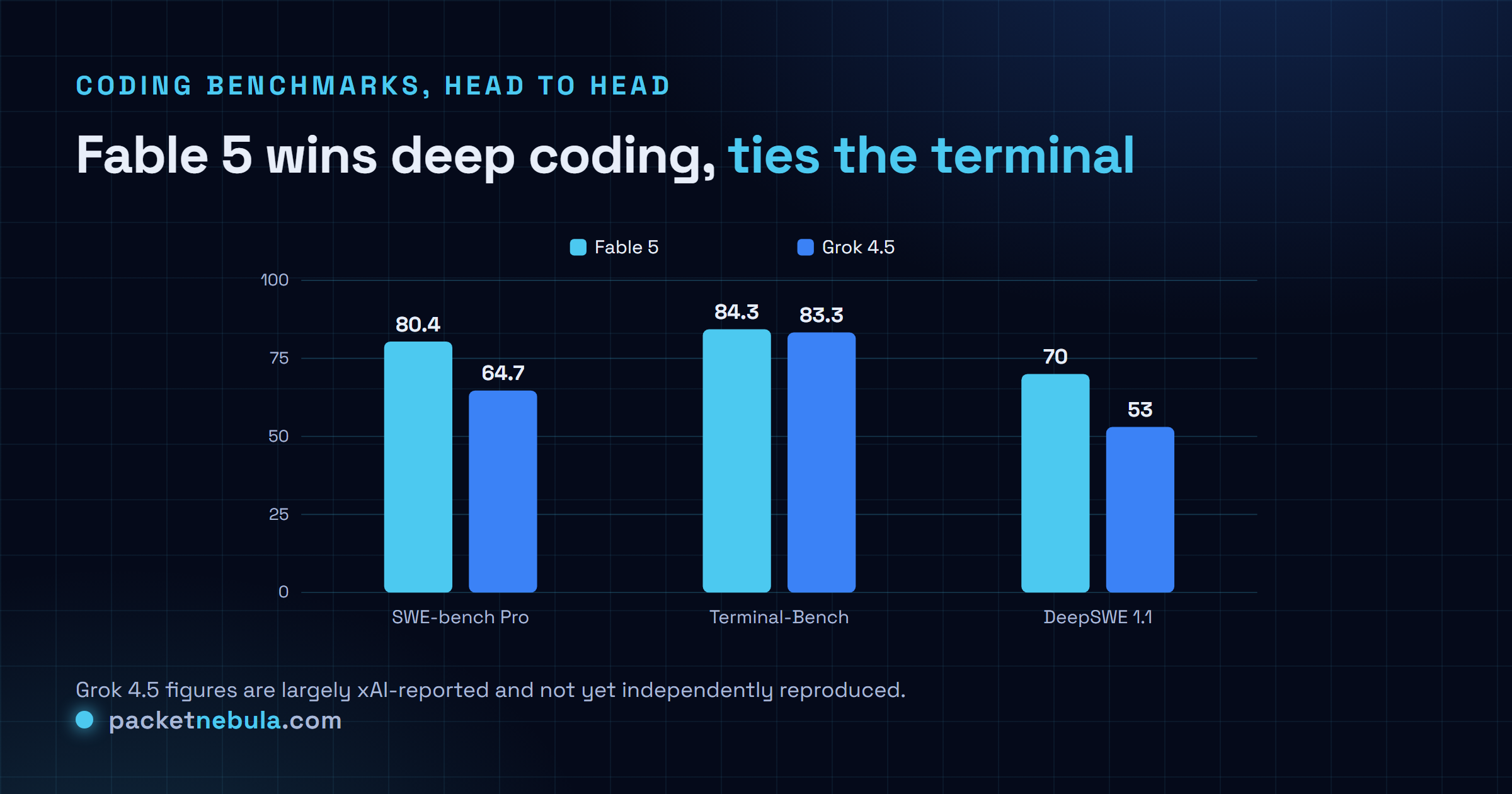
On composite third-party leaderboards, the gap is real. BenchLM's provisional ranking puts Claude Fable 5 ahead 92 to 75 in aggregate, with the biggest separation showing up in coding-heavy tasks. Independent benchmarking firm Artificial Analysis placed Grok 4.5 fourth overall on its GDPval-AA v2 real-world agentic knowledge work index — behind only Anthropic's latest Claude releases.
That said, Grok 4.5 isn't losing everywhere. On Terminal Bench 2.1, the gap shrinks to essentially a rounding error. And interestingly, an independent Snorkel AI evaluation using expert-authored professional workplace tasks (GDPval+) found Grok 4.5 actually posting the strongest mean pass rate of the group it tested — ahead of GPT-5.5 and Opus 4.8 specifically — with particularly strong results in legal, healthcare, and education task categories. Snorkel's test didn't include Fable 5 in that run, so treat it as evidence Grok 4.5 is stronger than the raw coding benchmarks alone suggest, not proof it beats Fable 5 broadly.
Pricing: This Is Where the Story Flips
| Model | Input (per 1M tokens) | Output (per 1M tokens) | Context Window |
|---|---|---|---|
| Grok 4.5 | $2 | $6 | 500K (1M coming soon) |
| Claude Fable 5 | $10 | $50 | 1M+ |
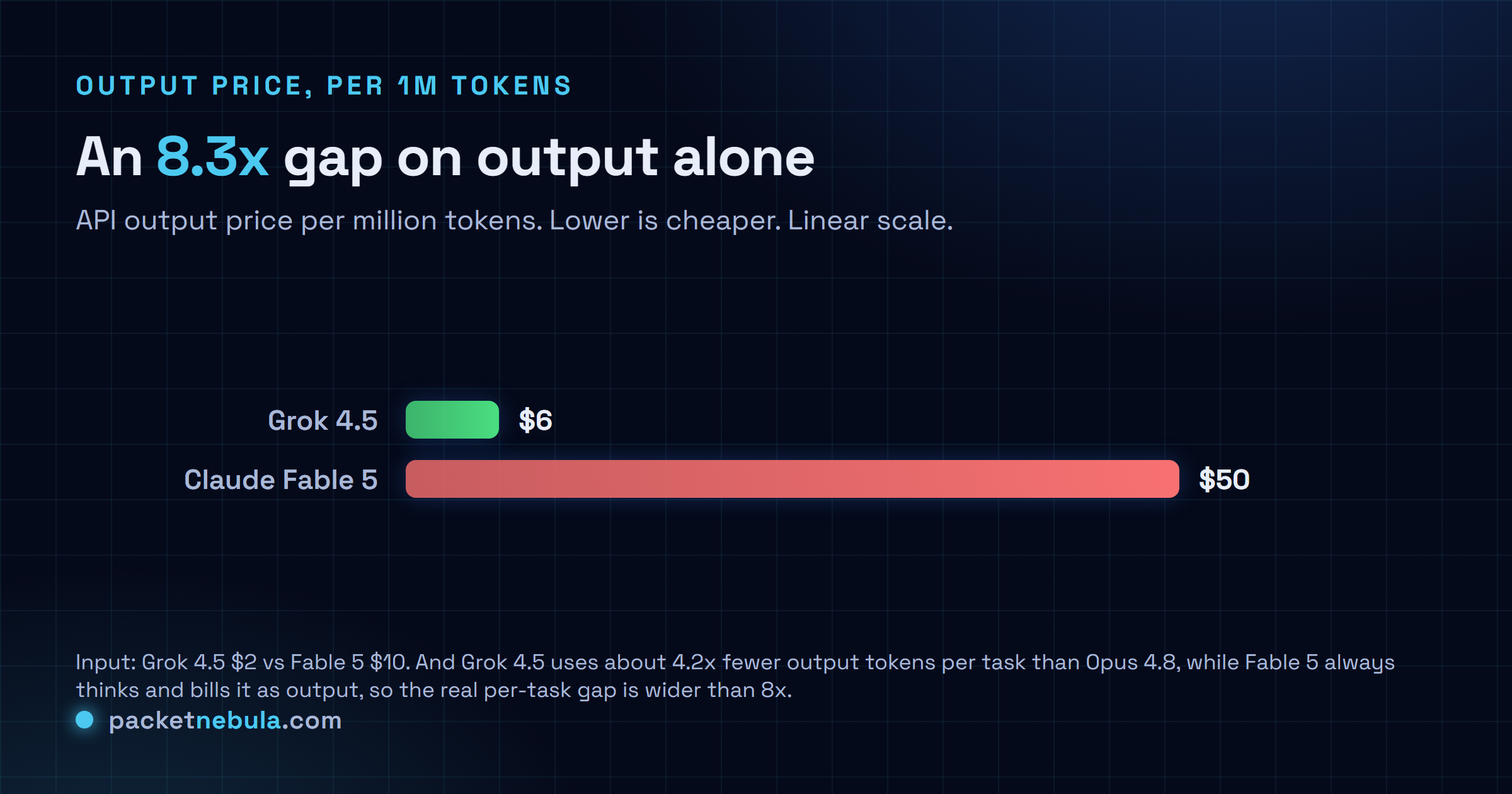
That's roughly 8.3x cheaper on output tokens. xAI also claims Grok 4.5 uses about 4.2x fewer tokens than Opus 4.8 to complete equivalent SWE-Bench Pro tasks, and Artificial Analysis independently measured Grok 4.5 at roughly $0.49 per completed task — calling it nearly 90% cheaper than the models ranked above it, and landing squarely on the price-performance Pareto frontier.
In plain terms: if a task costs $5 to solve on Fable 5, the same task might cost under $1 on Grok 4.5 — even accounting for a slightly lower success rate.
What People Are Actually Saying
This is where it gets more interesting than a spec sheet. A handful of independent testers and developers who've run both models on real work have converged on a similar take: Grok 4.5 isn't trying to be the smartest model in the room, and for a lot of practical work, that's fine.
One widely-shared developer reaction described being surprised at Grok 4.5's ability to build a working app with live data and 3D visualization from a single prompt, calling for new ways to benchmark that kind of output. Another prominent AI commentator called it the first xAI release to impress him in over a year, framing it as the best bang-for-buck model currently available given how close some benchmarks land to Fable-level intelligence at a fraction of the cost. A third widely-circulated take, from a developer who does extensive hands-on model testing, described Grok 4.5 as "really well priced" while also noting how crowded the frontier has become — several models now cluster near Opus-level performance, which somewhat blunts the significance of any single benchmark win.
The more measured commentary — including from AI researchers watching the space — frames Grok 4.5 less as "beats Fable 5" and more as "doesn't need to beat Fable 5" if you're running a multi-model setup: route the hard, judgment-heavy work to Fable 5, and offload the high-volume, well-defined agentic tasks to Grok 4.5 where its speed and cost advantage compounds.
So Which One Should You Actually Use?
- Choose Claude Fable 5 if: your work involves complex, ambiguous software engineering, you need the largest possible context window, or the cost of a wrong answer is higher than the cost of extra tokens.
- Choose Grok 4.5 if: you're running high-volume agentic workflows, doing rapid prototyping, or operating at a scale where token costs compound fast — and you can tolerate a slightly higher error rate in exchange for a dramatically lower bill.
- Best answer for a lot of teams: don't pick one. Route by task. Use Grok 4.5 as the default workhorse for routine agentic work, and escalate to Fable 5 for the tasks that genuinely need frontier-level judgment.
The Bigger Picture
This comparison is really a proxy for a bigger shift happening across the whole industry right now: models are starting to compete on economics, not just intelligence. Grok 4.5 isn't pretending to be the smartest model on the market — it's making the case that "smart enough, dramatically cheaper" wins for the majority of real-world workloads. Whether that argument holds up depends entirely on what you're building. For frontier research or the hardest engineering problems, Fable 5's lead is real and measurable. For everything else, the gap may matter a lot less than the price tag does.